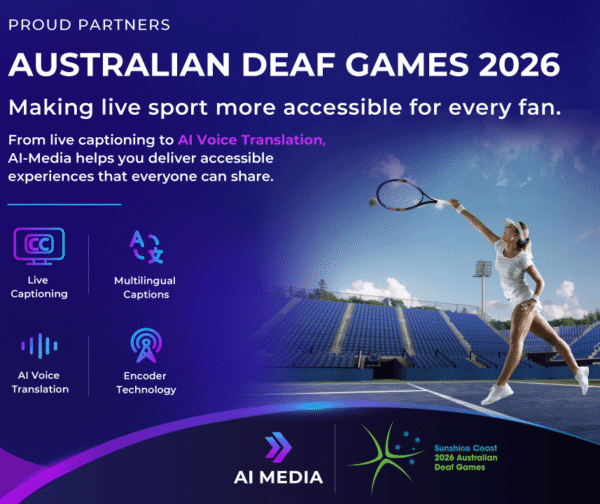
Captioning Events and Meetings: How Accessibility is Transforming Sports and Live Experiences
From international sporting competitions to community conferences and corporate events, the way we experience live moments is changing. Increasingly, accessibility is no longer seen as an optional add-on – it’s an expectation.
For Deaf and hard-of-hearing (DHoH) audiences, access to spoken content has historically been a barrier. But thanks to advances in live captioning – particularly cloud-based automated solutions – events of all sizes can now be more inclusive, engaging, and globally accessible than ever before.
Accessibility That Goes Beyond Compliance
It’s estimated that over 5% of the world’s population is hearing impaired. For sporting events like the Australian Deaf Games, accessibility is fundamental – not just to participation, but to the overall experience of competition, ceremony, and community.
However, the value of captions extends far beyond the DHoH community. Research shows that around 80%ii of caption users are not Deaf or hard of hearing. What starts as an accessibility requirement quickly becomes a better experience for everyone. The majority of users rely on captions for entirely different reasons – watching in noisy environments, following along in a second language, or improving comprehension.
This shift reframes accessibility as something bigger: a growth opportunity. When events are accessible, they become more inclusive, more engaging, and more scalable to broader audiences.
Why Captioning Matters for Sports and Live Events
Whether it’s a live match, an opening ceremony, a press conference, or a panel discussion, captions can transform how audiences connect with content:
- Enhancing Inclusion and Participation
Captions ensure that DHoH attendees and viewers can fully engage with commentary, announcements, and storytelling. This fosters a sense of belonging and equal participation – especially important in community-driven events like the Deaf Games.
- Boosting Engagement and Understanding
Captions improve comprehension and retention for all viewers. In fast-paced sporting environments or technical discussions, they help audiences keep up with key moments and information.
- Supporting Multilingual Audiences
Sport is global. Captions – and increasingly, translated captions – help break down language barriers, enabling international audiences to follow events in real time. With solutions like LEXI Translate, captions can be delivered in multiple languages simultaneously, opening events to broader and more diverse audiences. Taking this a step further, innovations like LEXI Voice enable real-time AI voice translation, allowing spoken content to be delivered in different languages live. This creates a more immersive and inclusive experience for global viewers, whether they are attending in person or tuning in remotely.
- Providing Flexibility in Any Environment
From stadiums to mobile devices, audiences consume content in different ways. Captions allow viewers to engage whether they’re in a noisy crowd, a quiet workspace, or on the move.
- Creating Lasting Value Through Transcripts
Captioning also produces accurate transcripts, which can be used for highlights, social media content, reporting, and archival purposes – extending the life and reach of an event.
Flexible Captioning Solutions for Every Event
Today, organisations have more options than ever when it comes to delivering accessible live experiences. From cloud-native workflows to dedicated encoder hardware and hybrid deployments, modern captioning solutions can be tailored to suit virtually any event environment.
Whether supporting large-scale sporting venues, broadcast productions, conferences, corporate meetings, or community events, accessibility technology has evolved to become more scalable, flexible, and easier to integrate into existing production workflows.
This flexibility is particularly valuable for sporting events and live productions, where infrastructure, connectivity, scale, and operational requirements can vary significantly. Some organisations may prefer cloud-based workflows for simplicity and rapid deployment, while others rely on trusted physical encoder solutions for broadcast-grade reliability and seamless integration into existing environments.
Making Captioning Simple and Scalable
Modern solutions – such as AI-Media’s encoder technologies paired with LEXI automated captioning – demonstrate how accessible event technology has evolved to support a wide range of workflows and production needs.
These solutions allow organisers to:
- Add live captions across broadcast, streaming, and in-venue experiences
- Support both cloud-based and hardware-enabled workflows
- Scale across multiple events, venues, or channels
- Deliver high levels of accuracy
For organisations seeking even broader accessibility, technologies like LEXI Translate and LEXI Voice enable real-time translation in both text and spoken audio, helping events connect with multilingual audiences in more immersive and inclusive ways.
This flexible approach reflects the evolving nature of live events themselves – designed to be accessible, scalable, and capable of reaching audiences wherever they are in the world.
Accessibility as a Growth Strategy
For events like the Australian Deaf Games, accessibility is central to the mission. But for the wider events industry, it’s also becoming a strategic advantage.
Accessible events:
- Reach larger and more diverse audiences
- Improve audience satisfaction and engagement
- Strengthen brand reputation and inclusivity
- Unlock new markets and global participation
In other words, accessibility isn’t just about meeting requirements – it’s about creating better experiences for everyone.
Looking Ahead
As expectations continue to evolve, captioning will play an increasingly important role in how we design and deliver events – across sports, business, and community settings.
The technology is improving. The demand is growing. And the opportunity is clear: to create events that are not only accessible, but truly inclusive, engaging, and global.